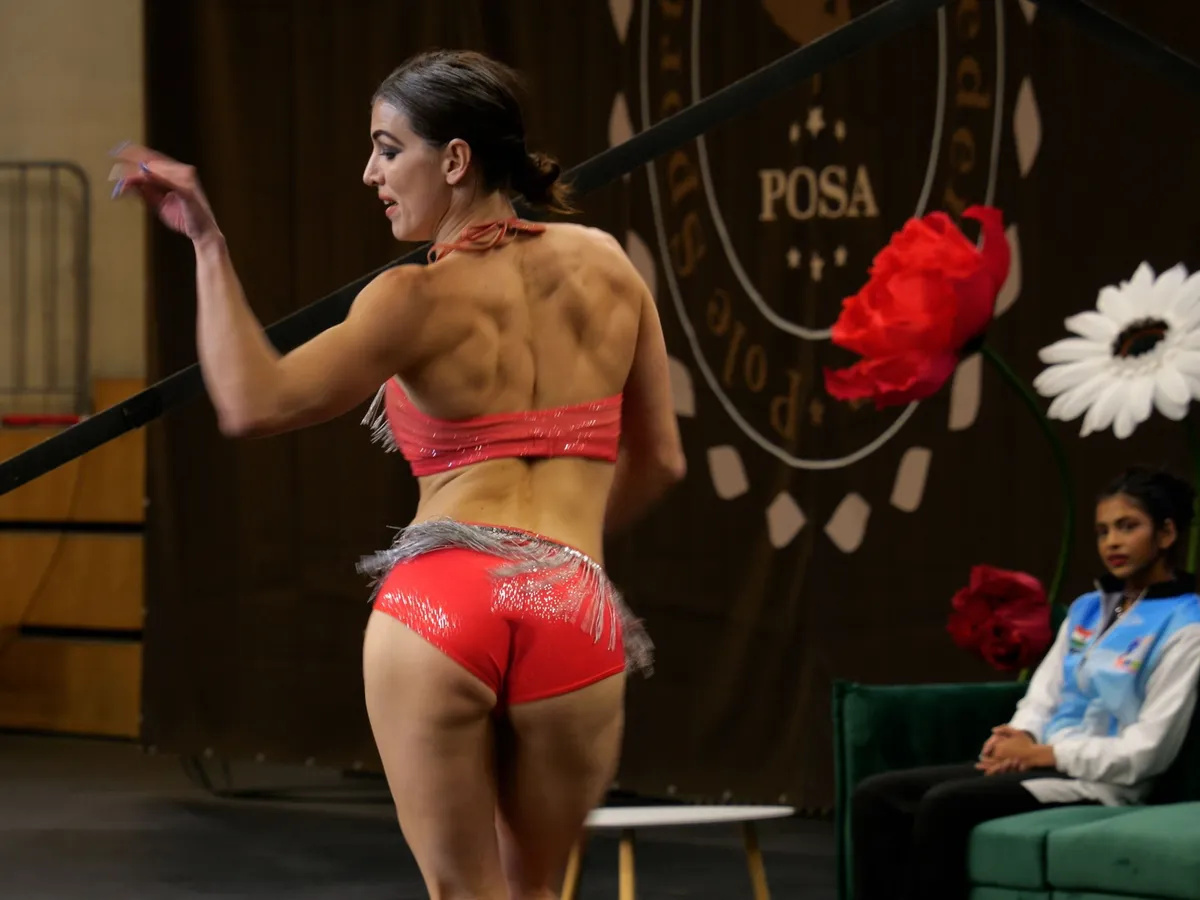
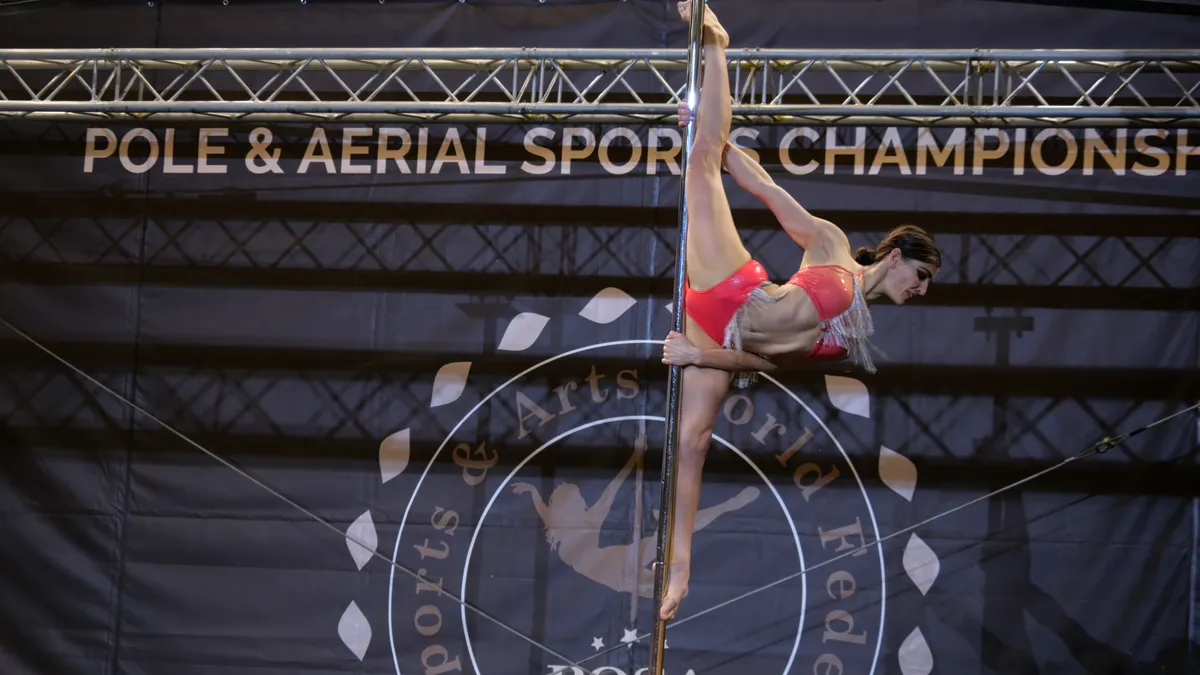
An exclusive portrait interview with Dorottya Litkei, one of the standout figures of Hungarian pole sport, on her past, present and future. The multiple Hungarian champion sat down with Botond Sziráki-Modla, journalist at Sportál.
A fact few people know: in 2025 Hungary is hosting the international Pole and Aerial Sports World Championship. The organiser is the Hungarian Aerial Sports Federation (MALESZ), which has coordinated this segment of Hungarian sport since 2018, from 2024 as an official sport organisation. Between December 8 and 14 this year they take a huge step forward, when the entire aerial sports world turns its attention to Hungary.
MALESZ is the only Hungarian representative of the Pole Sports and Arts World Federation (POSA), which is how they earned the right to host this prestigious event on home soil.
Although pole dance has been present in the country since 2008, it is still considered a niche pursuit — yet thousands can now call it part of their everyday lives. The federation, however, is very young, without access to state funding, and companies and private sponsors are not yet lining up to invest. The athletes are classed as amateurs, and even though Hungary has produced multiple European champions, those competitors have prepared, travelled and stayed at world events entirely at their own expense. This year's World Cup may prove to be the turning point.
When I first landed on the MALESZ website, the very first image that greeted me was of today's interviewee — Dorottya Litkei — multiple Hungarian champion and, among many honours across her 10-plus-year career, an amateur European champion. When I reached out to talk about the sport and about her, she answered every question honestly and directly. Although she said she'd never done anything like this before, she was composed and articulate throughout. We laughed a lot, and there were also genuinely tender moments, which I've tried to convey here to the best of my ability.
Dorottya — or Dotti, as almost everyone calls her — invited me to one of her private training sessions so we could talk there; that way, she said, I could see what she does rather than just hear about it. She was already deep into her session when I arrived, working on her World Championship choreography.
When I saw her, I didn't just see an athlete — I saw the embodiment of endurance and human strength. Behind the muscle lies an unbending will that has broken through every wall of the past ten years. I watched, in awe, as she rose above prejudice and carved a path where others might have found only closed doors or disbelief. Her movement isn't just about sport — it's about the possibility of human freedom. It was in that state of awe that I approached her with my questions, which she answered openly.
What led you to pole sport? What was your athletic background?
As a child I already attended a sports school where I trained in both individual and team disciplines. At eight I started acrobatic rock & roll, and it became clear that dance would be my form of fulfilment — I just didn't yet know in what shape. At fourteen I started Latin dance, and for the first time in my life I felt I had arrived. I still do it today as a hobby. I've put an unbelievable amount of work into making sure my movement — on the dance floor and on the pole — reflects my inner world in every circumstance. The intensity with which I threw myself into competitive dance isn't quite human — at least that's how I see it. Not to mention the period when, at nineteen, I met pole sport and started doing both in parallel. It was pure madness! — she laughs.
Do you see yourself more as a Latin dancer or a pole athlete, given that dance is "only" a hobby now?
I get that question often — do I prefer dance or the pole? — and to this day I can't answer, because I feel one couldn't exist without the other anymore…
"But somewhere deep in my heart I'll always be more of a dancer and an artist than an athlete."
What drives you more in your career — the joy of movement or the promise of winning?
Clearly the first… which then brings the second — she laughs. I've always believed that if someone can be truly themselves on stage, that is far more lasting than any material thing, say a medal.
While I listened, I pictured the beginnings: the childhood momentum, the first steps, the first dance classes. At that age you don't yet know what life is going to ask of you. You just feel the body move, and inside that movement lies the promise of freedom.
When you hit walls — visible and invisible — what gives you the strength to cross them?
I won't say what I've achieved is down to luck, because I consciously shaped my life to live from my passion. I'm grateful for the environment and the people I get to work with. What gives me strength? Hm… Seeing what I've been through, where I came from, what personal victories I've had in my life. I can see how much depends on my own mind. My awareness is what propels me.
"I know I'm capable of creating anything I want for myself."
Has there been a day when you felt it might all be over? How does faith in the next step get reborn?
Yes, everyone has days like that. It's completely fine for things to change and for other things to become the priority. I don't want to stop teaching or leave pole sport, but by putting it in the right place in my life I've become much more balanced. I no longer want to sacrifice my whole life for it.
"This is an unwalked path that often feels frightening, but I believe this will be a wonderful chapter too."
What does the silence of training mean to you — a battle with yourself, or a spiritual journey?
"More the latter. I feel an immeasurable gratitude in those moments. Seeing, feeling and experiencing what my body is capable of is unbelievable in itself."
As we talked about the struggle, I pictured those walls that most of us would only call obstacles. For her, every wall is a doorway. It's as if she finds a home in difficulty — as if fatigue and doubt are simply new terrains for her victories. I listen, and wonder: why does my own momentum break so easily? She, meanwhile, holds a rhythm as though endurance were nothing more than breath — natural, necessary, non-negotiable.
How does it feel to face people who doubt you — and how do you turn their doubt into strength?
I engage with other people's opinions as little as possible. I am responsible for my own life; their thoughts aren't mine. So there's no opinion for me to fight.
"I stay open toward everyone when it comes to judgment."
Have you had to face prejudice born from people's lack of awareness? How did you handle it?
Thank God, personally — no! Have you seen these shoulders? — she flexes. — People see the athlete in me first and are more curious about what I do. The other day, for example, a stranger — an older lady — grabbed my bicep in a shop. — she laughs.
If your career so far were a poem, would it be a sad one or a cheerful one?
"Radnóti — Forced March. Or some kind of tragicomedy. Or something wryly motivating, in Örkény's style. The palette is quite colourful."
What colours and sounds would you use to describe your movement?
Colours? Hm — turquoise, grass green, orange, sun yellow, with a few black dots here and there. And there's one piece of music that's been defining for me my whole life. The main theme of The Theory of Everything — I think it was written for me. That is so Dotti — she smiles.
When she speaks of movement as a poem, a melody rises in me too. I see her body writing lines into the air — every lift, every point of the toe another rhyme. Sport becomes poetry: a rhythm that echoes not only in the audience but inside us too. Listening to her, I realise that poetry might be hidden in my own everyday movements as well — if I dare to notice it.
What path do you see ahead — rising peaks, or a slowly widening horizon?
I feel I climb my mountains differently now. I think I've reached my goals as a competitor and I'm content with that. It doesn't mean I don't want more or that I don't want to become the best version of myself again and again — but differently.
"Who knows — this year may be my last competition."
What would you like others to take away from what they see in you?
"Live in the moment. Be present, let time stand still, and enjoy it."
Do you try to pass this mindset on to your students too? Your approach is very spiritual — are the students open to it?
I feel I find the right depth in my communication with everyone. They can count on me for many things — as a coach and as a person, I'm here for them. I want to show them there's another way. But of course, I'm not a missionary, and this isn't a cult! — she laughs.
Which of your results as a competitor are you most proud of? Why?
That's a very hard question, because five come to mind at once. Each is special for a different reason, and I'm proud of every one.
And as a coach?
ALL OF THEM! REGARDLESS OF AGE, GENDER, ANYTHING! Because it's my creations they take to the stage — and that is the most beautiful gesture a competitor can make for their coach. It's an honour that they chose me. Great responsibility and enormous trust. I try to bring the best out of everyone.
What makes 2025 particularly special for you, with the Pole Sport World Championship being held at home?
Financially it'll certainly be lighter. I don't have to spend as much on travel and accommodation — she laughs. This year I'm preparing a piece no one is ready for. Not even me. I'm certain it will be an unforgettable year!
Can you imagine pole sport becoming an Olympic discipline in your lifetime?
"If it does, I definitely want to be part of it."
Those on the outside don't see how complex this sport is, how much preparation it demands and how little room there is for error. I think it deserves a chance at the Olympics — but unfortunately, in the supposedly enlightened society of the 21st century, the mere mention of "the pole" still stirs prejudice in most people.
When her last word fades, a silence settles between us. I know she wasn't only talking about her sport, but about how one stays human in a world where it would often be easier to give up. The endurance she radiates finds an echo in me too — as though she'd handed me a small piece of the strength I so admire. And so we stand: she on the stage, I in front of the screen — but both of our paths lead toward freedom.
Originally published in Hungarian on Sportál, 27 August 2025. Translated for reference.